For many Australian businesses, Safe Work Method Statements (SWMS) are an everyday part of managing workplace safety.
They're created before high-risk work begins, reviewed during audits and often requested by clients before work can commence.
But here's an uncomfortable question.
Is your SWMS actually protecting your workers?
For many businesses, the honest answer is "probably not."
That isn't because the document is poorly written.
It's because a SWMS only reduces risk when it influences how work is planned, supervised and performed.
A well-written document sitting in a folder doesn't prevent incidents.
People do.
A SWMS Is a Planning Tool
A SWMS isn't intended to be another form to complete before starting work.
Its purpose is to identify:
- the high-risk activities
- the hazards involved
- the controls that will reduce those risks
- who is responsible for implementing those controls
In other words, it should help workers understand how the job will be completed safely.
When treated this way, a SWMS becomes a valuable planning tool.
When treated as paperwork, it becomes little more than evidence that someone completed another form.
The Most Common Problem
One of the biggest problems seen across many industries is that SWMS are produced, signed and then forgotten.
The sequence often looks like this:
- Download a template.
- Change the company name.
- Obtain signatures.
- File the document.
- Never look at it again.
Nothing about that process improves safety.
The hazards still exist.
The risks remain.
The paperwork simply creates the appearance that safety has been addressed.
Workers Haven't Read It
Ask yourself a simple question.
If you stopped one of your workers halfway through the day and asked them to explain the critical controls in the SWMS they signed that morning, could they?
In many workplaces, the answer would be no.
That's rarely because workers don't care.
It's often because:
- the document was too long
- it wasn't discussed
- it didn't reflect the actual work
- it was signed with little explanation
- conditions changed after work commenced
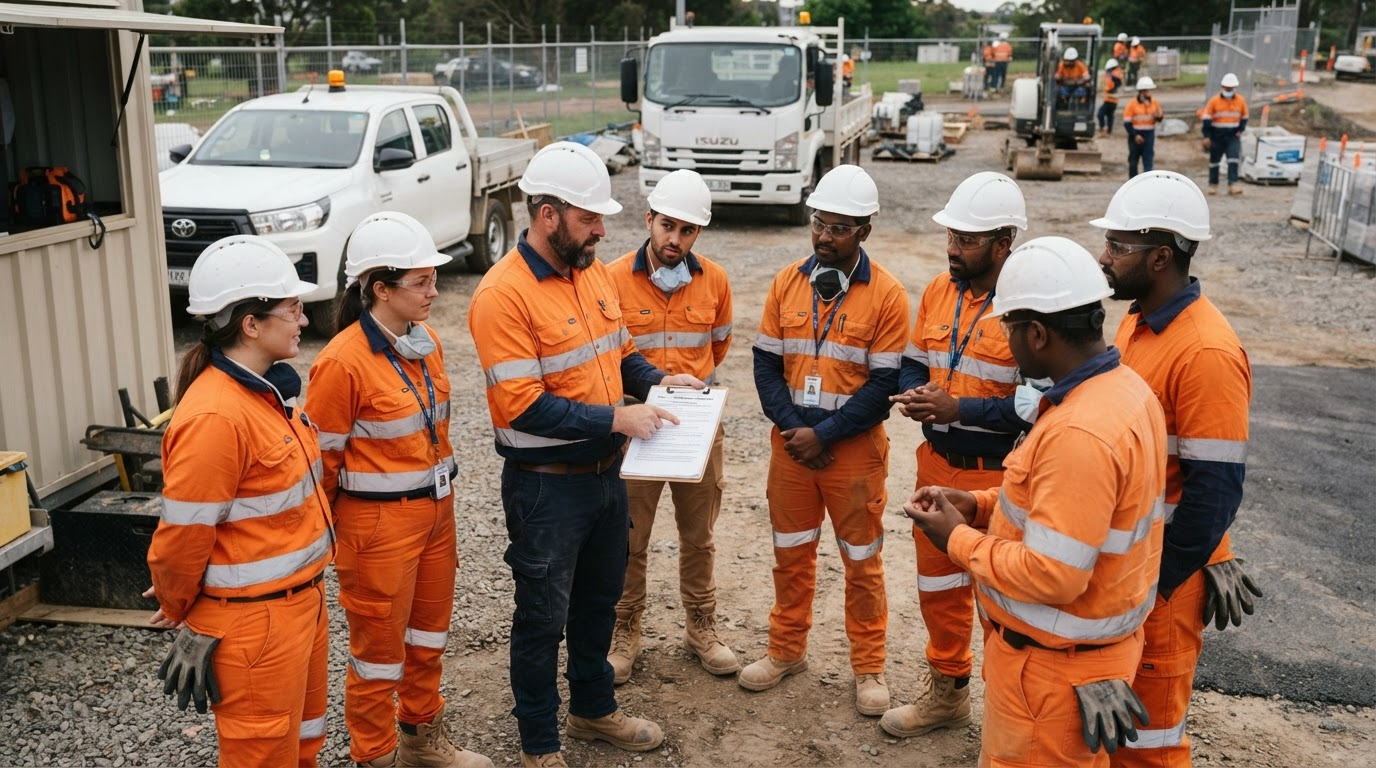
A SWMS should start conversations.
It shouldn't replace them.
Conditions Change
No worksite stays the same for long.
Weather changes.
Plant moves.
Other contractors arrive.
Deliveries are delayed.
Ground conditions vary.
Unexpected hazards appear.
A SWMS developed in the office yesterday cannot predict every circumstance.
That's why supervision and regular pre-start discussions remain essential.
The document provides the foundation.
People apply it to the changing conditions.
Good Supervision Makes the Difference
The best supervisors don't simply ask workers to sign a SWMS.
They use it to discuss:
- today's hazards
- changing site conditions
- environmental factors
- new risks
- responsibilities
- emergency arrangements
Those discussions often identify issues that aren't written in the document.
That's where real risk reduction happens.
The paperwork supports the conversation.
The conversation protects the workers.
Keep Your SWMS Practical
A common misconception is that a longer SWMS is a better SWMS.
Often the opposite is true.
Workers are far more likely to engage with documentation that is:
- relevant
- concise
- written in plain language
- specific to the task
- regularly reviewed
Avoid copying generic templates that describe hazards your workers will never encounter.
Instead, focus on the work actually being performed.
Review It When Work Changes
A SWMS should never become a "set and forget" document.
Review it whenever:
- the scope of work changes
- equipment changes
- new hazards are identified
- incidents or near misses occur
- workers identify better ways to control risk
Continuous improvement keeps the document useful.
Digital Doesn't Automatically Mean Better
Many businesses are moving to electronic SWMS systems.
Digital tools certainly make documentation easier to access, update and distribute.
However, technology alone won't improve safety.
A digital SWMS that nobody discusses is no better than a paper version sitting in the site office.
Technology should support better communication—not replace it.
Turning Documentation Into Protection
A SWMS begins protecting workers when it becomes part of everyday work.
That means:
- discussing it before work begins
- reviewing it when conditions change
- involving workers in its development
- ensuring supervisors actively refer to it
- checking that the nominated controls are actually in place
When these habits become routine, the SWMS stops being a compliance document.
It becomes a practical safety tool.
Final Thoughts
Most businesses don't need more SWMS.
They need to make better use of the ones they already have.
A practical, well-understood SWMS that reflects the work being undertaken will usually do far more to reduce risk than dozens of generic documents sitting in a filing cabinet.
If your SWMS have become a paperwork exercise rather than a planning tool, now is the perfect time to review how they're being used.
Practical Safety Advisory helps Australian businesses develop practical SWMS that support real work, encourage meaningful safety conversations and improve day-to-day risk management—not simply satisfy compliance requirements.