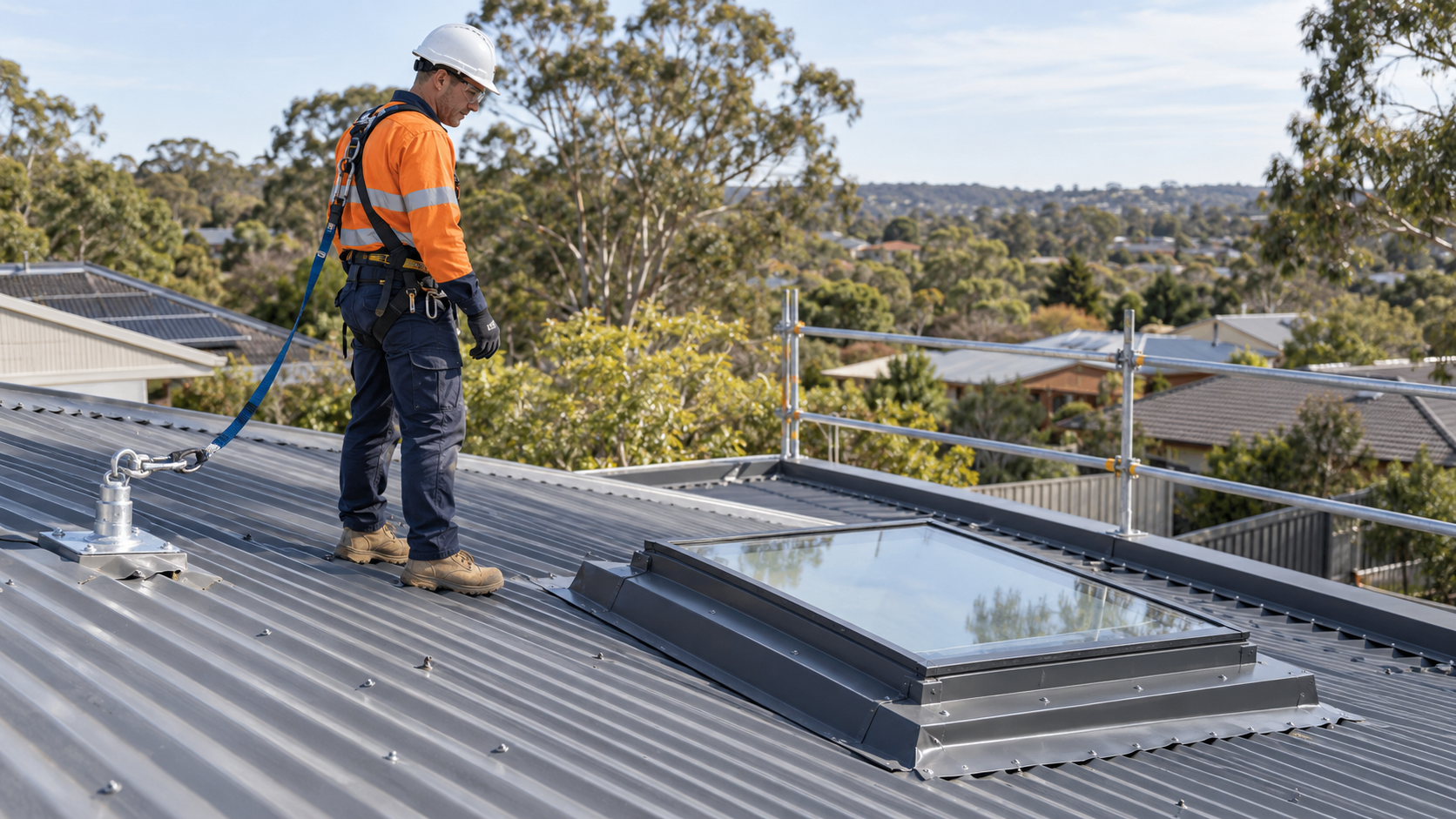
A contractor fell 6.74 metres through a skylight on 10 January 2024. On 22 May 2026, the Brisbane Magistrates Court fined the company that had connected subcontractors with small jobs $90,000 for a work health and safety offence. The regulator’s summary was published on the decision date.
The contractor suffered a significant brain injury requiring emergency surgery, as well as a broken hand, spinal fractures and lacerations.
What happened
The company used contractors for jobs such as cleaning, pest removal and possum removal, usually in residential homes. The court matter concerned work at height and the company’s failure to meet its primary health and safety duty.
The company had not obtained further details about the work and passed them on to the contractor. The regulator’s summary also identified gaps in procedures for checking workers’ training, licences or qualifications; identifying hazards; confirming height-safety training; and providing information and instruction about the work and available controls.
What the court found
The company pleaded guilty to an offence under section 32 of the Work Health and Safety Act 2011 (Qld), relating to a failure to comply with its primary duty under section 19. The failure exposed an individual to a risk of death or serious injury, and the risk eventuated when the contractor fell through the skylight.
In sentencing, the court took into account that the company had not put control measures in place, had made no assessment or enquiries about the risk, and that the work was objectively dangerous. The steps needed to reduce the risk were not overwhelming. The company’s lack of criminal history and guilty plea were also considered.
The court noted that a penalty of $100,000 to $150,000 would otherwise have been appropriate, but took account of the company’s business downturn and reduced capacity to pay. The company was fined $90,000, with no conviction recorded. It was also ordered to pay $1,500 in professional and legal costs and $115.50 in court costs. These amounts are separate from the fine.
The court considered that specific deterrence was less relevant because the company no longer conducted this type of work, while general deterrence remained important to encourage safe workplaces.
Why this matters to business managers
Using contractors or arranging work through subcontractors does not remove the need to understand the work being done and manage the risks connected with it. Work at height can involve serious fall risks, including where a worker may encounter a skylight or another surface that may not safely support their weight.
Managers need practical systems that operate before work starts: gather enough detail to assess the task, identify foreseeable hazards, check that workers are competent for the work, and select and communicate effective controls. A policy alone is not a substitute for checking that controls are suitable for the job and actually in place.
What managers should take note of
- Clarify the task before approving it. Obtain details about the location, work method, access and surfaces, and share relevant information with the people doing the work.
- Identify fall hazards. Consider skylights and other fragile or uncertain surfaces as part of the task-specific risk assessment.
- Check competency and authority. Use a process to verify relevant training, licences, qualifications and experience for the work being undertaken.
- Set and confirm controls. Identify measures to eliminate or minimise fall risks, communicate them clearly and check they are in place before work begins.
- Give task-specific instruction. Explain the nature of the work, hazards and controls to workers and contractors; do not assume they already know the site or task.
- Use relevant guidance. The regulator’s summary referred to Queensland’s Managing the risk of falls at workplaces: Code of Practice 2018 as relevant guidance for work at height.
- Review contractor arrangements. Make sure procedures cover how work is scoped, risk-assessed, approved and monitored, including when subcontractors are involved.
Source information
- Regulator/source: Workplace Health and Safety Queensland
- Source type: Regulator summary; no court judgment, tribunal decision or sentencing remarks were attached to the source record
- Decision date: 22 May 2026
- Source: Workplace Health and Safety Queensland court report
This article summarises the regulator’s account of the matter and is general educational information, not legal advice.