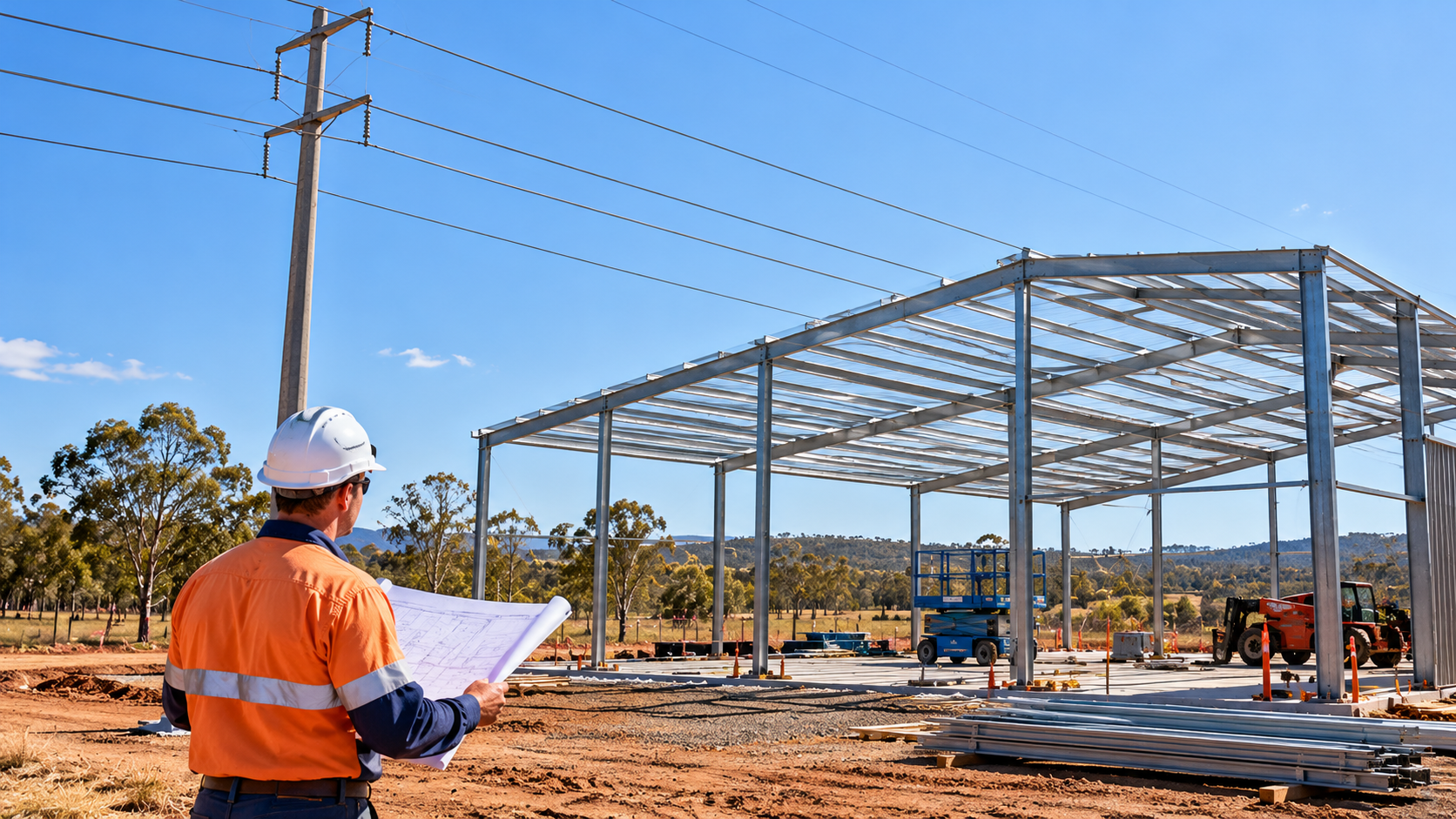
On 30 January 2025, the Gympie Magistrates Court fined a company $80,000 for failing to ensure its work was electrically safe while installing a shed near an overhead transmission line. The case is a reminder that managers should verify powerline status and plan safe work controls rather than relying on an unconfirmed assurance that a line is de-energised.
What happened
The company was engaged to install a shed at a property in Curra, Queensland. An overhead transmission line passed over the premises at a height of 7.8 metres. The regulator’s summary states that the line’s voltage required a three-metre exclusion zone, including operating plant.
The regulator’s narrative says the shed was erected between 23 and 28 June 2021. Workers and/or conductive materials they were holding came within an unsafe distance of the line. At the closest points, the shed and line were 1.4 metres apart. The company had been told by the property owner that the line was de-energised, but it remained live throughout construction. No construction workers were injured during the shed installation.
In October 2021, after the shed had been built, the property owner engaged a roofer to install gutter guarding. The roofer received an electric shock while on the shed roof, from contact with or proximity to the line, and suffered serious electrical burns.
Court outcome
The company pleaded guilty to an offence under section 40C of the Electrical Safety Act 2002 (Qld), relating to its duty under section 30 to ensure, so far as reasonably practicable, that its business or undertaking was conducted in a way that was electrically safe.
The court imposed an $80,000 fine and did not record a conviction. The regulator’s summary also lists $1,500 in professional and legal costs and $101.40 in court costs, separate from the fine.
The regulator reported that the court considered the company’s duty was not removed by failings of other potential duty holders, although the conduct of others was relevant to assessing the probability of the risk. The summary says possible controls identified in the case included assessing whether the work would come within an unsafe distance of the line, obtaining written confirmation from the electricity network operator that the line was de-energised, not starting until de-energisation was confirmed, and avoiding construction within an unsafe distance. These are described in the regulator’s summary as alleged control measures, rather than presented here as separate court findings.
Why this matters to business managers
Powerlines can create a serious risk even when workers do not directly touch them. The work area, materials, tools, plant and later maintenance tasks all need to be considered. A shed may be completed without injury, yet its position can leave workers or contractors exposed during follow-on work.
The case also shows why a verbal assurance about isolation should not be treated as proof that a line is safe. Managers need a reliable process for identifying who can confirm the line’s status, documenting that confirmation and ensuring the work does not begin until required controls are in place.
What safety managers and supervisors should take note of
- Identify overhead lines during planning. Check the work area, access routes, plant movements and the full structure being installed—not just the immediate task.
- Assess the required exclusion zone. Confirm the applicable distance for the line and the work, including operating plant and conductive materials.
- Verify isolation through an appropriate source. Do not rely solely on an informal assurance. Obtain and retain written confirmation where required, and establish that the line is de-energised before work starts.
- Set clear stop-work conditions. Make sure workers and contractors know who can authorise work to proceed and what to do if line status or clearances are uncertain.
- Coordinate duty holders and later work. Share information about overhead hazards with contractors and anyone who may work on or near the structure after installation.
- Record the risk assessment and controls. Keep evidence of the hazard assessment, decisions, confirmations and briefings, and review controls if the scope or work conditions change.
Source information
- Regulator/source: Office of the Work Health and Safety Prosecutor, Queensland
- Source type: Regulator summary
- Decision date: 30 January 2025
- Source limitation: The available material is a regulator summary; no court judgment or sentencing remarks were attached to the source record.
- Source URL: Official source document
- Publication date: Not stated in the supplied source material.