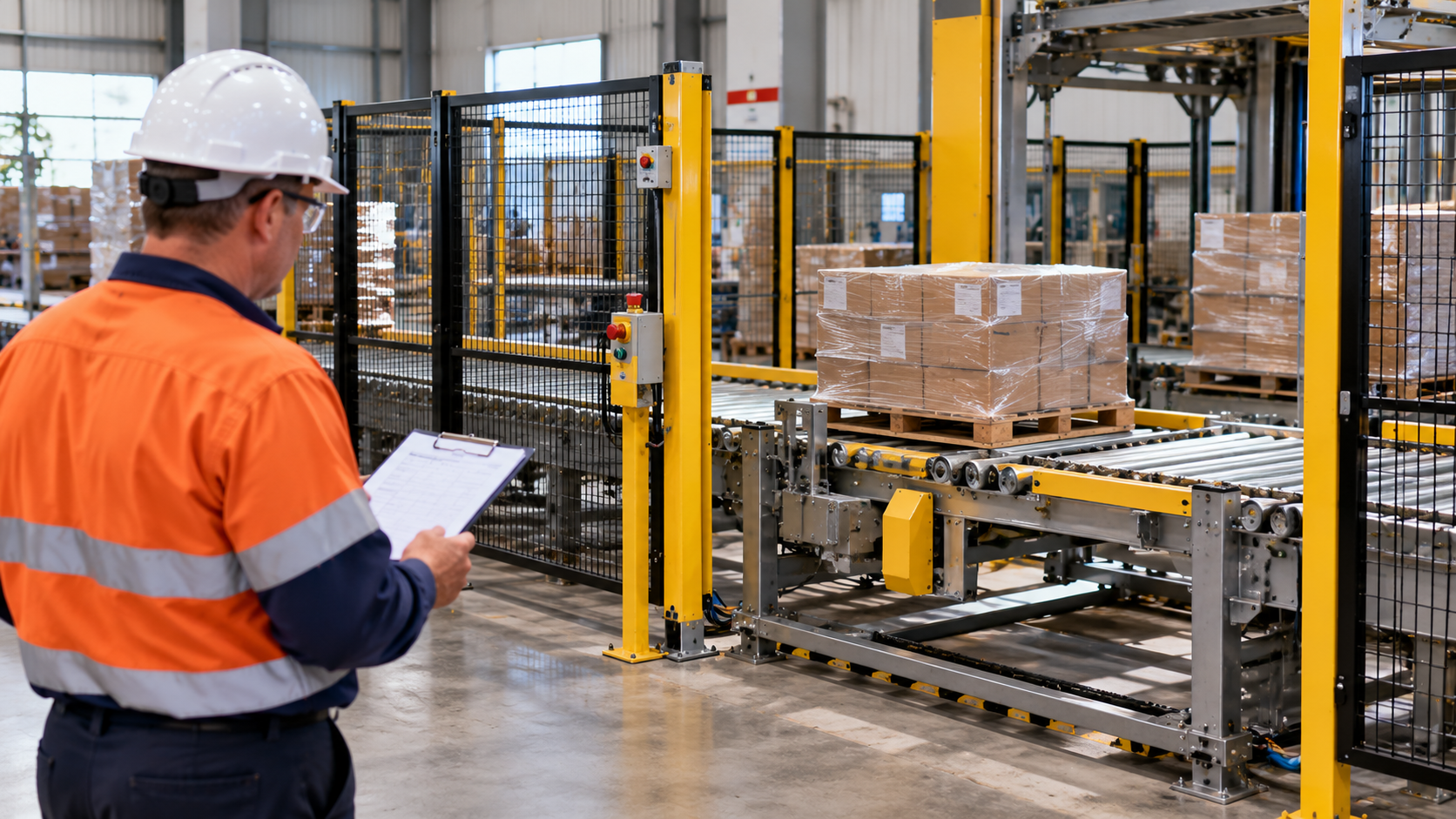
A worker’s left ankle was crushed on 20 December 2022 while clearing a jammed pallet on an energised conveyor. On 26 October 2026, the Industrial Court of NSW fined the business operating the bag line $807,500 for a category 2 work health and safety offence.
The decision is a practical reminder for managers: when workers have to intervene in machinery to clear recurring jams, the task needs a safe, clearly communicated system—not informal methods passed between workers.
What happened
The conveyor was used to package, wrap and stack 25kg bags of polyethylene beads. A loaded pallet became stuck between sections of the line. After trying to move it using the controls, the worker used a crowbar to adjust the pallet while standing on the conveyor’s wrapper turntable.
The line was still energised. When the pallet came free, the conveyor resumed its automatic cycle and the pallet moved forward, trapping the worker’s leg. The worker suffered a fracture to the left ankle and required surgery. The court record describes ongoing effects, including permanent impairment and restricted work capacity.
The incident date was 20 December 2022. The decision and publication dates were both 26 October 2026.
What the court found
The business pleaded guilty to failing to comply with its work health and safety duty, exposing a worker to a risk of death or serious injury. The court recorded a conviction and imposed a $807,500 fine. That amount reflected a 15% reduction from a $950,000 fine for the guilty plea. The business was also ordered to pay the prosecutor’s costs as agreed or assessed; 50% of the fine was payable to the prosecutor.
The court found there was no safe work procedure for dislodging jammed pallets that required the conveyor’s energy sources to be isolated first. It also found the business had not provided adequate supervision, instruction, information or training for the task. The worker had learned jam-clearing methods informally and had not been trained in how to isolate the line or made aware of its automatic cycle.
The court considered the risk of contact with moving machinery foreseeable in the circumstances. Pallet jams had become frequent, and workers were required to respond to them, but there was no documented procedure setting out how to do so safely. The court also noted that a manual crowbar intervention could expose a worker to serious harm if the line remained live.
Why this matters to managers
A jam may seem like a routine interruption, especially when workers have cleared similar problems before. But repeated manual intervention around moving plant can create a predictable exposure to serious injury. Informal know-how, general inductions or the presence of guards do not necessarily address the specific risks of a task.
The decision highlights the need to connect the hazard, the control and the way work is actually done. A written procedure must be practical and understood by workers; training must cover the relevant plant and task; and supervision should check that the controls are being followed. Where isolation is required before a worker enters or reaches into machinery, the process needs to be clear and workable.
What managers should take note of
- Review recurring jams and interventions. Treat repeated stoppages as a reason to reassess the task and its risks, rather than relying on workers to improvise.
- Set a safe jam-clearing method. Document what workers should do, including when to stop work, who to contact and what controls must be in place before manual intervention.
- Address stored and moving energy. Where the safe method requires isolation, specify the isolation and lock-out steps and ensure workers know how to apply them.
- Train and check competence. Provide task-specific instruction on the equipment, its automatic operation and the required controls. Keep suitable training and competency records.
- Provide effective supervision. Make sure workers can access a competent supervisor or an agreed escalation process when a jam cannot be cleared using the approved method.
- Check that procedures work in practice. Consult workers, observe the task where safe to do so, and review controls when equipment, materials or operating conditions change.
This article is general information about a court decision, not legal advice. Businesses should assess controls in the context of their own plant, tasks and workforce.
Source information
- Source: NSW Caselaw
- Source type: Industrial Court of NSW decision
- Citation: [2026] NSWIC 63
- Decision date: 26 October 2026
- Published date: 26 October 2026
- Source URL: Official source document