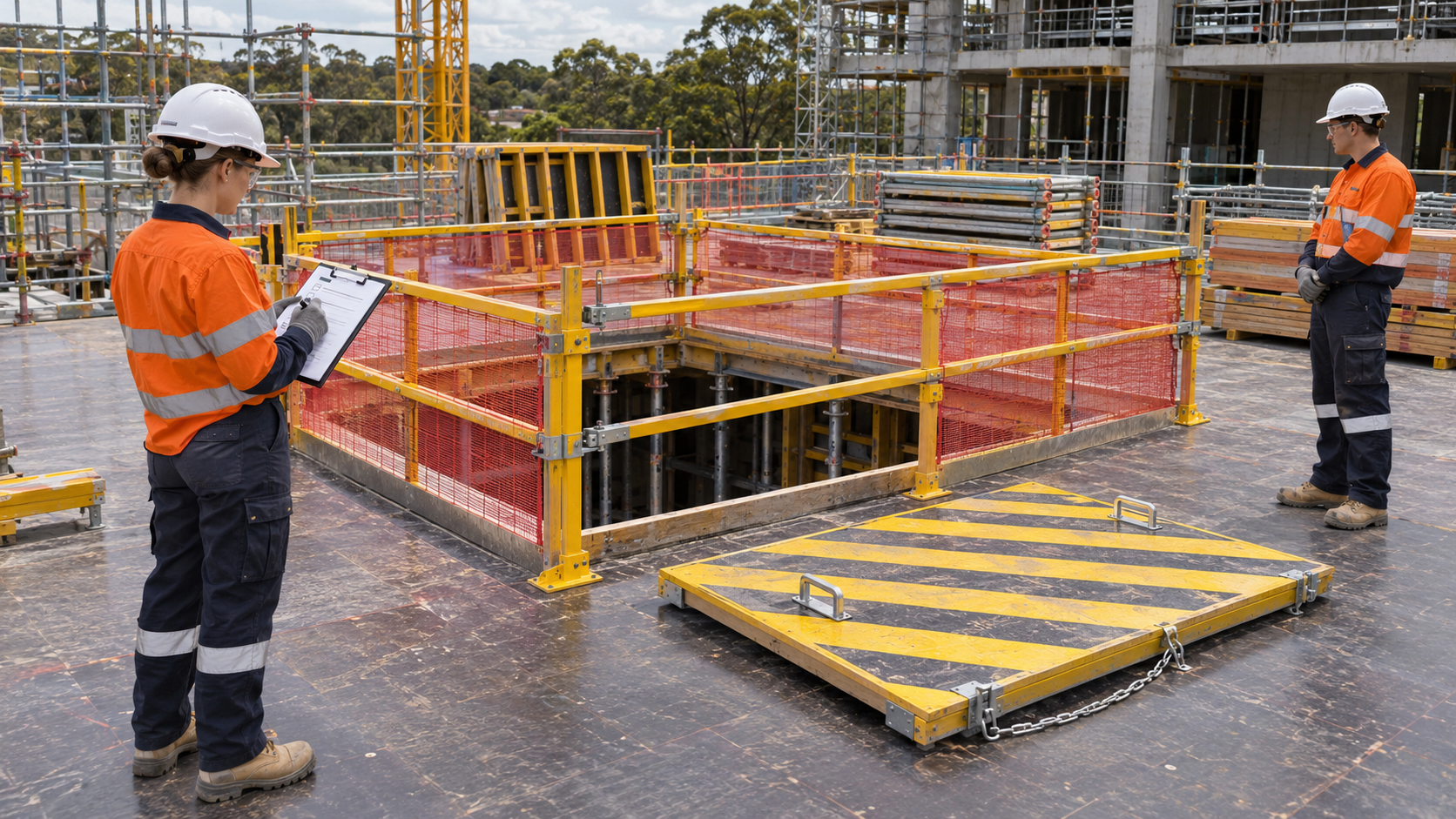
On 2 November 2026, the NSW District Court fined a formwork contractor $75,000 after it pleaded guilty to a work health and safety offence involving a worker’s fall through a formwork deck. The incident occurred on 19 May 2022 at a construction site in Chatswood, NSW.
What happened
Scaffold access to the work area had been closed while access arrangements were being addressed. Workers used a ladder to reach the formwork deck, and a box-system panel was removed to create an opening for that access. After the ladder was removed, a panel was put back, but it was initially not sitting flush with adjacent panels. A piece of plywood was fixed over it and was not marked to show that it was attached to a panel.
The court record says the supervisor did not check how the ladder had been removed or how the opening had been covered. A later deck inspection and handover checklist did not require an inspection from below or specifically prompt checks for plywood attached to formwork panels. The usual inspection practice was to inspect from above.
On 19 May, a 16-year-old trainee worker was cleaning the deck and consolidating materials. When the worker lifted the plywood, the attached formwork panel became dislodged, leaving an opening. The worker fell about 3.4 metres to the level below and sustained multiple soft-tissue injuries.
The court’s decision
The contractor pleaded guilty to failing to meet its duty under section 19(1) of the Work Health and Safety Act 2011 (NSW). The offence was that the failure exposed workers to a risk of death or serious injury, contrary to section 32.
The court described falls through formwork decks as a well-known and foreseeable risk. It identified deficiencies across the system of work, supervision and training, including the lack of specific instruction on dealing with objects attached to formwork panels and weaknesses in the inspection and handover process.
The court set a fine of $100,000 before applying a 25% reduction for the guilty plea, resulting in a $75,000 fine. It also ordered the contractor to pay the prosecution’s sentence-hearing costs, as agreed or assessed, and to fund and arrange publication of a public notice. Those costs and publication expenses are separate from the fine.
Why this matters to managers
A temporary access change can create a sequence of new risks: an opening is made, a panel is reinstated, a cover is added, and another worker later encounters the altered surface while doing a different task. A document or sign-off is not enough if the inspection process does not identify the hazard that was actually created.
For managers, the practical issue is whether controls remain effective as work changes. A handover should verify the physical condition of the deck and any openings, not simply record that checks have been completed. Temporary covers and panels also need to be recognisable, secure and managed so they cannot be moved in a way that creates a fall hazard.
What formwork managers and supervisors should take note of
- Control access changes: When scaffold access is unavailable or altered, reassess how workers will reach the work area and how any temporary opening will be protected. Record who approves the arrangement and who verifies it.
- Check reinstated panels: Verify that panels are correctly positioned, level and secure after any ladder or other temporary access is removed. Escalate anything that does not fit or sit as intended.
- Treat attached materials as a hazard: Make sure workers can distinguish a protective cover from ordinary materials. Avoid arrangements where moving plywood or other loose materials could lift or dislodge a formwork panel.
- Inspect from the right places: Design handover checks to verify the condition of the deck and panels, including from below where appropriate. Make the checks specific to the hazards and changes on that deck.
- Keep work away from unverified areas: Prevent access to areas with an unprotected opening or uncertain panel condition until a competent person has checked and controlled the hazard.
- Match training and supervision to the task: Ensure young, inexperienced or trainee workers receive task-relevant instruction and supervision, including clear limits on where they may work.
- Review controls when work changes: A safe work method statement and toolbox discussion should reflect the actual access method, temporary alterations, inspection arrangements and handover requirements in use.
These are practical management considerations drawn from the case, not legal advice. Employers should assess controls against their own work, workers and site conditions.
Source information
- Source: NSW Caselaw
- Source type: District Court of New South Wales decision
- Decision date: 2 November 2026
- Source URL: Official source document