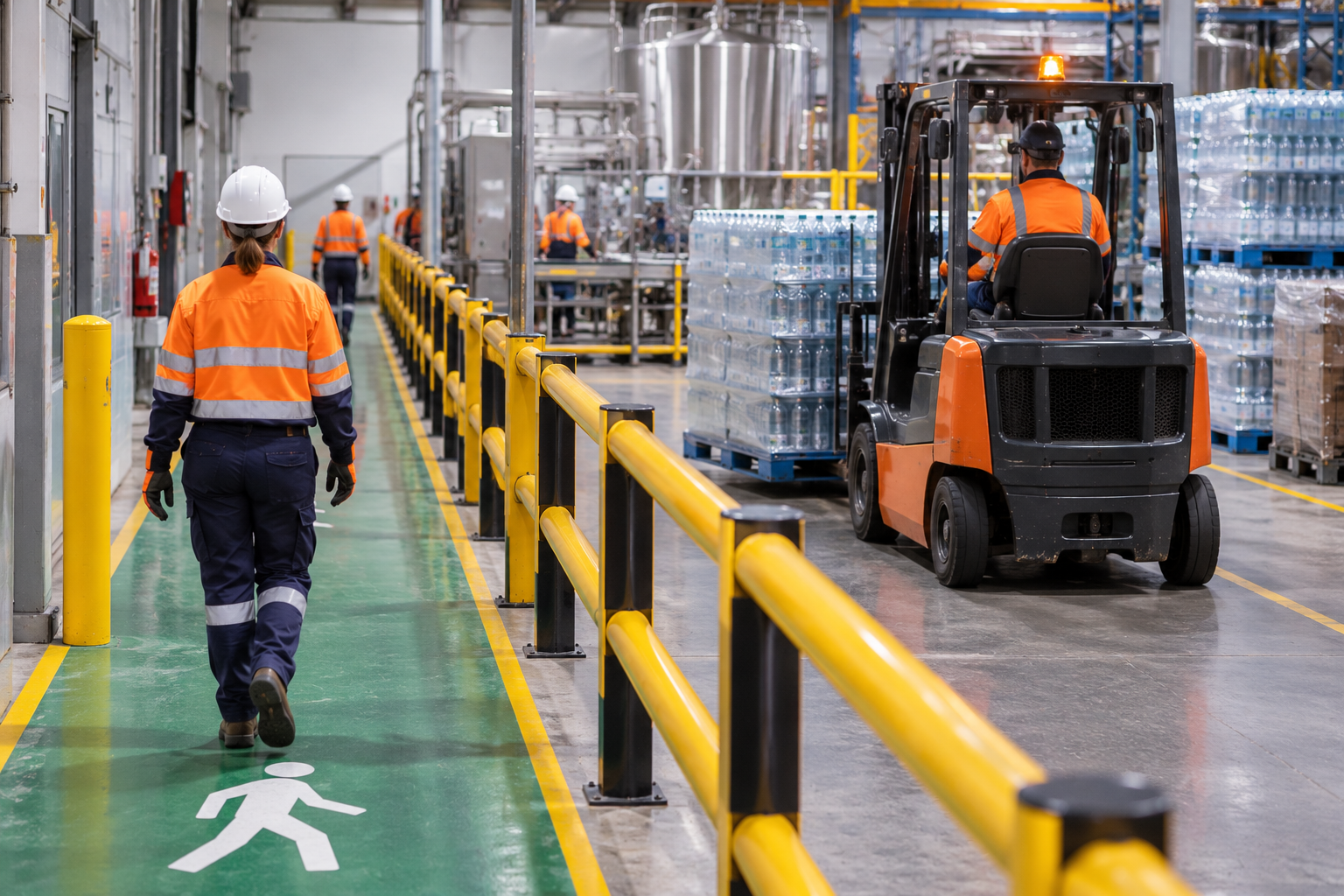
On 26 June 2026, the Industrial Court of NSW convicted a corporate employer and its director after a lab assistant sustained serious injury when struck by a forklift in a bottling line area.
The corporate defendant was fined $240,000 and made subject to a publicity order. The director was fined $9,600. The matter followed an investigation by SafeWork NSW.
What happened
The incident occurred on 9 November 2022. A lab assistant was struck by a forklift in the bottling line area and sustained serious injury.
The SafeWork NSW summary states that the company was charged under sections 32 and 19(1) of the Work Health and Safety Act 2011, while the director was charged under sections 32 and 27(1). The source reports that both defendants were convicted on 26 June 2026.
The available source is a regulator summary rather than a stored court judgment or sentencing decision. It does not provide further detail about the specific traffic-management failures, the circumstances immediately before the collision or the court’s detailed reasoning. Those matters should be confirmed against the official court material before being stated more broadly.
Penalties and regulatory action
The penalties attached to the parties were different:
- the corporate employer received a $240,000 fine;
- the director received a $9,600 fine; and
- the corporate employer was also made subject to a publicity order under section 236(a)(i), as reported in the regulator summary.
These outcomes should not be treated as interchangeable. The company’s fine and publicity order were separate from the director’s personal fine.
Why this matters to managers
Forklifts and other mobile plant can operate in busy areas where workers, contractors and visitors may also be present. A general instruction to take care, or reliance on operator awareness alone, may not be enough to control the risk of a person being struck.
Managers should be able to demonstrate that pedestrian and vehicle movements have been assessed and that controls are implemented in the work area. Controls should be practical for the layout, work sequence, visibility, lighting, noise, traffic volume and types of people using the area.
A useful review should consider whether:
- pedestrian and forklift routes are physically separated where reasonably practicable;
- designated crossings are clearly marked and positioned to provide good visibility;
- speed limits, exclusion zones and right-of-way rules are understood and enforced;
- forklift operators and pedestrians receive instruction appropriate to the site and their tasks;
- loading, unloading, reversing and queuing activities are managed safely;
- visitors, contractors and temporary workers are included in the traffic-management arrangements;
- changes to plant, layout, production or staffing trigger a review of the controls; and
- inspections, maintenance, training, consultation and corrective actions are recorded.
What managers should take note of
Treat forklift–pedestrian interaction as a system-design issue, not only an operator-behaviour issue. Start with a site walk-through and map every point where people and mobile plant can meet.
Then assign a responsible person to implement each control, set a completion date and verify that the control works during normal operations and higher-risk activities such as shift changes, cleaning, maintenance and production peaks.
Supervisors should also check whether the documented system matches what happens on the floor. If workers routinely cross through forklift routes, visibility is obstructed or exclusion zones are not maintained, the risk assessment and controls may need to change.
The incident occurred on 9 November 2022. The conviction, fines and publicity order were reported on 26 June 2026, which was also the publication date supplied for the regulator summary.
Source information
- Regulator: SafeWork NSW
- Source type: Regulator summary
- Court: Industrial Court of NSW
- Decision date: 26 June 2026
- Source limitation: No court judgment, tribunal decision or sentencing remarks were attached to the supplied material. The specific factual findings and detailed sentencing reasons should be confirmed before publication of any additional claims.